Teaching With Koriko


The state of the world is pretty bleak right now. State governments all across the United States, my home, are continuing to soldier forward in their efforts to write people like me out of existence and law alike. My country is embroiled in yet another senseless, meaningless, reasonless war. The global economy is strained. We find out every day that people we admired as heroes are actually monsters. Tech companies continue to push products that strip us of our ability to think critically and engage creatively with each other. Every time I see a post online, I have to spend minutes evaluating whether it's even real. We pipe our clean drinking water into unceasing machines while the atmosphere above our heads gets thicker and thicker.
It's easy to feel like reality is breaking down, like society is doomed, like everything is coming to an end. But I don't feel that way. And in large part, that's because I teach kids, and without getting into specifics about my students, many of them are extraordinary.
Collaborative Storytelling Through Tabletop
The wordiest elective offered to middle schoolers this side of the Mississippi
When I'm not moonlighting as a game designer of unbelievably modest renown, I work as a school librarian. I work with a pretty wide age range, but I want to focus on one very specific aspect of my job: I teach a middle school elective called Collaborative Storytelling Through Tabletop, and in my time at this school, it's become explosively popular. Last year, the elective was structured around a series of lectures and play demos that took my students through various genres and formats of TTRPGs:
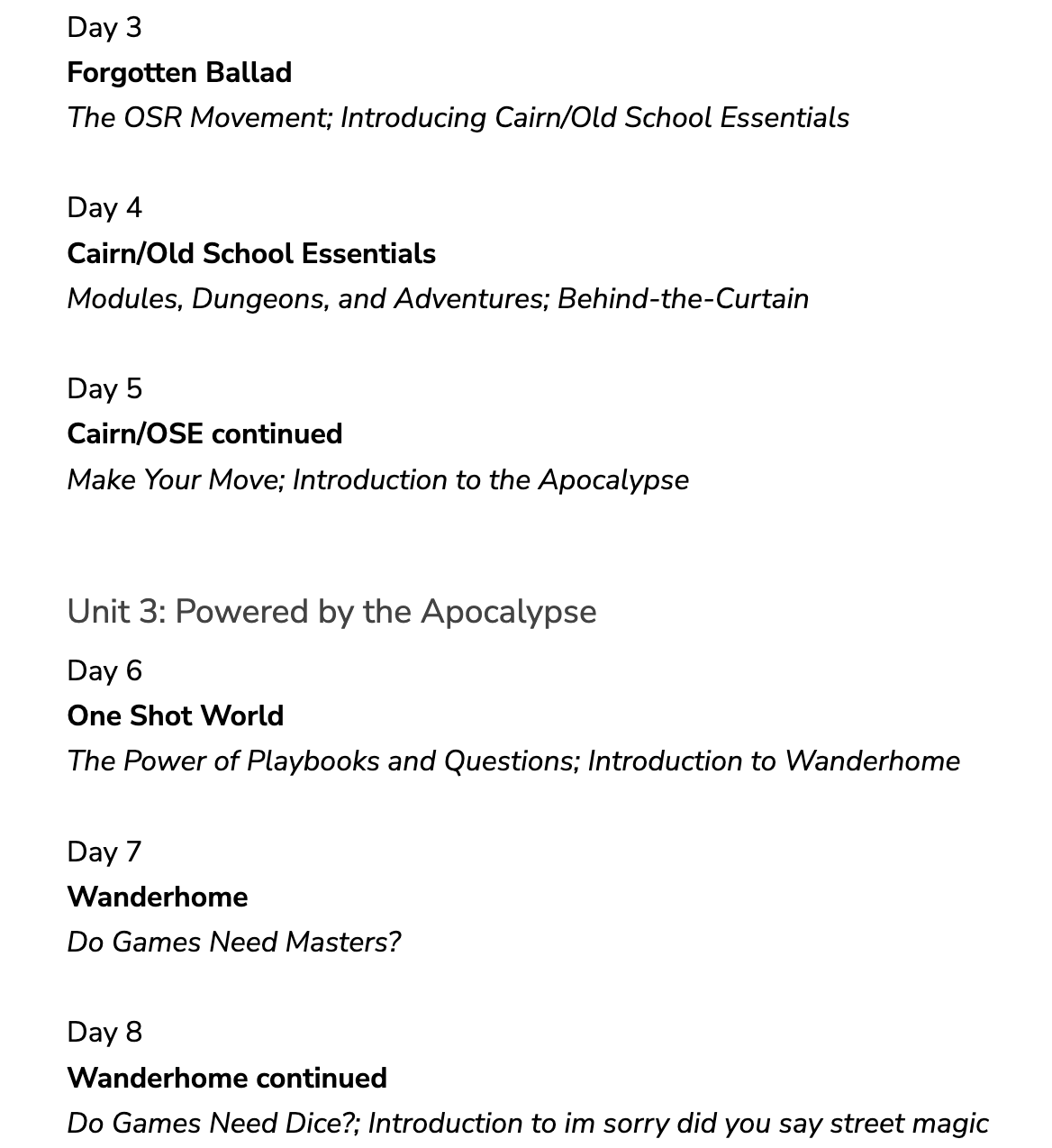
The elective was tremendously successful, and I would love to devote a later post exclusively to the structure and content of the lectures and demos that I taught. This year, though, the class time for the elective was shortened considerably... and the number of students that signed up for my elective ballooned. Suddenly, I was looking at 30-minute blocks with 10 or more middle schoolers all wanting to play at the table together. How the hell was I supposed to swing that?
The solution: instead of finding a game for 10 players that supports a long-form campaign with half-hour sessions that are entirely school-appropriate (extremely difficult, if not impossible), go the other direction entirely. Go solo.
It's pretty elegant, once you wrap your head around it. If everyone is sharing a single character, they're forced to share the mic in order to progress the story. Students are forced to come to a consensus, or at least a majority agreement and compromise, so that they can move the game forward. Everyone feels like the game is at least partially their own—that they're a genuine stakeholder in the fiction. And if someone is sick for a day, we don't need to plot-hole their character, because their character is everyone's character. Once the idea occurred to me, it was a bit of a forehead-smack moment. How could I have missed this? It's just so obvious.
I did a quick trial run with another student group before the Collaborative Storytelling elective started, selecting Jason Price and Jack Harrison's exquisite Heavy Weighs the Crown as the guinea pig for my experiment. In case you haven't read it before, Heavy Weighs the Crown is a storytelling game "of magical crowns, the monarchs who wear them and the realms they rule together." I was drawn to it for a variety of reasons, but the biggest one is that it's a solo game that explicitly states that you can play it with a group.
The game is awesome, and we had a great time with it. I also noticed that students that tended to be quieter had an easier time asserting their opinion during the game specifically because their contributions felt lower stakes. It was a great blend of narrative tropes, and the story that we told felt bold, original, and delectably dramatic. I had a blast. Consider this a resounding endorsement of Heavy Weighs the Crown: if you're looking for a game that can help you tell a dramatic tale with all the ups and downs of an epic monarchy, look no further.
By the end of the playthrough (which lasted around three weeks), I knew that a journaling game was definitely the right approach. The question was... what to pick for a semester-long campaign?
Enter Koriko: A Magical Year
Who wouldn't like Koriko?
The first day of my elective, I prompted students to think about the kinds of stories they were interested in telling. As a group, we settled on something light-hearted but not too silly, something that skewed fantasy but stayed grounded in reality, and something with a narrator that the group could relate to. What better fit could there be than an urban fantasy coming-of-age story inspired by Kiki's Delivery Service? And to top it all off... it's one of my personal favorite journaling games (sorry Tim, but Thousand Year-Old Vampire isn't exactly preteen material, so it didn't make the cut for my class).
Koriko: A Magical Year by Jack Harrison of Mousehole Press needs very little introduction. The game got so popular that it's completely sold out of print copies. A lot of that, I think, has to do with the game's broad tonal appeal: Koriko bottles up the melancholy of teenage loneliness, the excitement of exploring a new city, and the bubbling magic of a bright and fantastical world and gives it to you in a digestible (yet expansive) game that guides you step-by-step through your own version of Kiki's Delivery Service. It's hard not to love it. I mean, Kiki's is my dad's favorite Ghibli movie, and that guy has great taste.
There were a few logistical problems with the game that I had to solve before I got it off the ground. For one, there was the practical matter that Koriko required dice stacking. We play in the school library, and I was not confident that a rogue third grader wouldn't knock stacks over in between play sessions. Luckily, Harrison included alternate rules involving pulling stones from a bag, which has worked brilliantly for us. A couple of velvet bags with colored glass beads did the trick, and the tactile nature of the game was preserved. Some of my favorite moments in the game so far have come from a student slowly pulling stones one-by-one as everyone leans over the edges of their seats and tells them not to screw us all over by pulling the wrong one.
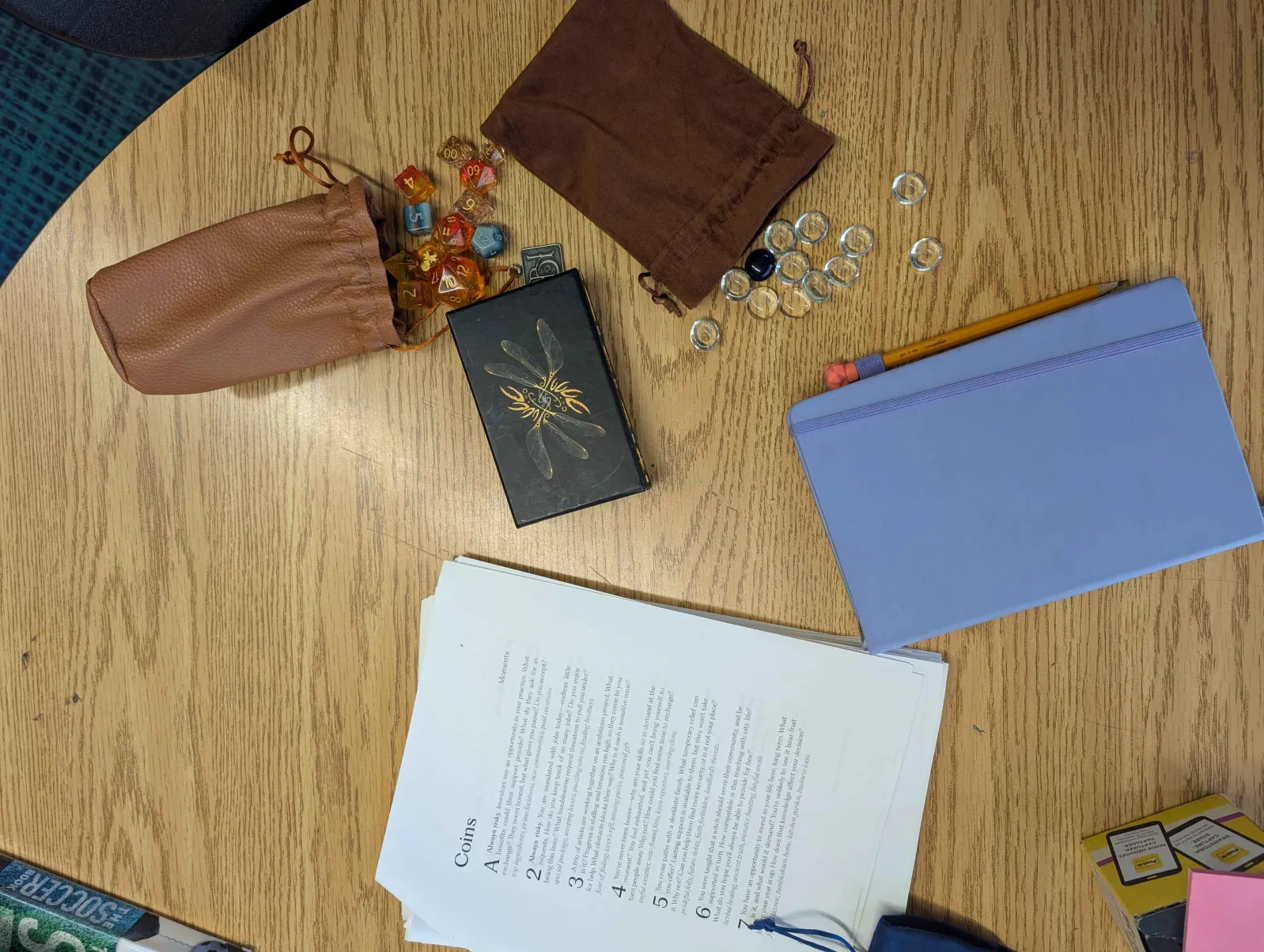
The second practical matter: if we're playing a journaling game with over 10 people, who's going to do the journaling? I devised a system in which one student would write each day, acting as the live editor of all our thoughts and dialogue. Another student would handle all physical materials (largely to avoid arguments about who gets to touch the shiny, shiny tarot cards). I drafted it all up in a handout which I gave to the students on the second day of the elective:
How to Share Koriko: A Magical Year
Koriko: A Magical Year is a fantastical solo journaling game from Mousehole Press, written by Jack Harrison. It’s a bubbling cauldron of simple rules and writing prompts, stirred together to produce the story of a teenage witch spending a year away from home in an unfamiliar city called Koriko. You don't need to have played a roleplaying game before—this isn’t much like most of them anyway. A passing familiarity with witches, urban exploration and teenage drama is all the background you’ll need.
That being said, the way that we will be playing Koriko is a little different. Koriko is designed for a single player, but we will be playing with a group of as many as eleven people, over the course of many months. Because of this, some of the rules will need to be adapted, altered, or summarily discarded. This document will serve as a guide to how we will be playing Koriko and how it will differ from the base text.
One Mic, One Journal, Many Voices
We will all be sharing a single, physical journal. This journal will anchor our entire playthrough of the game: everything we discuss will be recorded, every decision that we make will add to the journal. However, having eleven people stooping over a journal and trying to write in it at the same time is, quite frankly, a nightmare. Thus, I have devised a few roles that will rotate over the course of our elective.
Koriko’s story is split into six sections, called volumes. Within each volume, we will create a series of journal entries, culminating in a letter home to our witch’s mentor. Each journal entry will be fairly short—two or three paragraphs on average. The letters will be a bit longer and more involved.
What’s important to keep in mind, though, is that all of the journaling we’re doing is going to be in character as this witch. As such, even though the journal entries are short, they still take time and focus to create, because we’re penning them from the perspective of a fictional character.
At the beginning of each elective period, we will assign two roles:
- The Scribe will be responsible for writing the journal entries for the day.
- The Clerk will be responsible for handling the physical materials for the day, such as tarot cards, dice, and stones.
Roles will be assigned randomly each day, but you are always allowed to opt out of a role if you do not want to do it.
At the end of each volume, we will be responsible for writing a letter to our witch’s mentor. This calls for a special role: the Scrivener. The Scrivener will be responsible for taking the journal home with them and writing a letter in between elective classes. Because the Scrivener is a role that involves homework, it is opt-in as opposed to opt-out. Thus, at the end of each volume, I will ask for volunteers to write the witch’s letter, and select randomly from among those who have not already been the Scrivener before.
How To Be a Scribe
The Scribe is a particularly demanding and tricky role to play, because it requires you to be able to listen and write at the same time. Everyone’s brain works differently, so I don’t want to tell you how you NEED to play the Scribe, but here’s my suggestion:
- Start by listening and talking to the group. We may all need a little time at the beginning of each entry to work through ideas and settle on a consensus.
- Once the group has settled on a thread, start writing the journal entry. If at any point people are talking over each other or are moving too quickly for you to keep up, say “PAUSE” to halt the conversation.
- Use Post-It notes in the journal to take bullet-point notes about the conversation as it goes on if you need help keeping track of information before turning it into fictional journal entries.
- If you get tired or need a break, tell us! I’ll stop the game for a bit and change gears.
As the Scribe, you’re also responsible for editing the group’s conversation down into a coherent narrative. If people make suggestions that don’t make any sense or which you can’t figure out a way to fit in, write it on your Post-It note, but omit it from the journal entry.
We're now a few months in, and it's gone better than I ever could have hoped. Our journal is teeming with sketches, commentary, and delightful moments with our witch (whose name is Pidgin). Everyone has found a voice in the story, whether they're someone who typically steps up or sits back. We're halfway through the Arrival volume, and I can't wait to see what the rest of our journey is like.
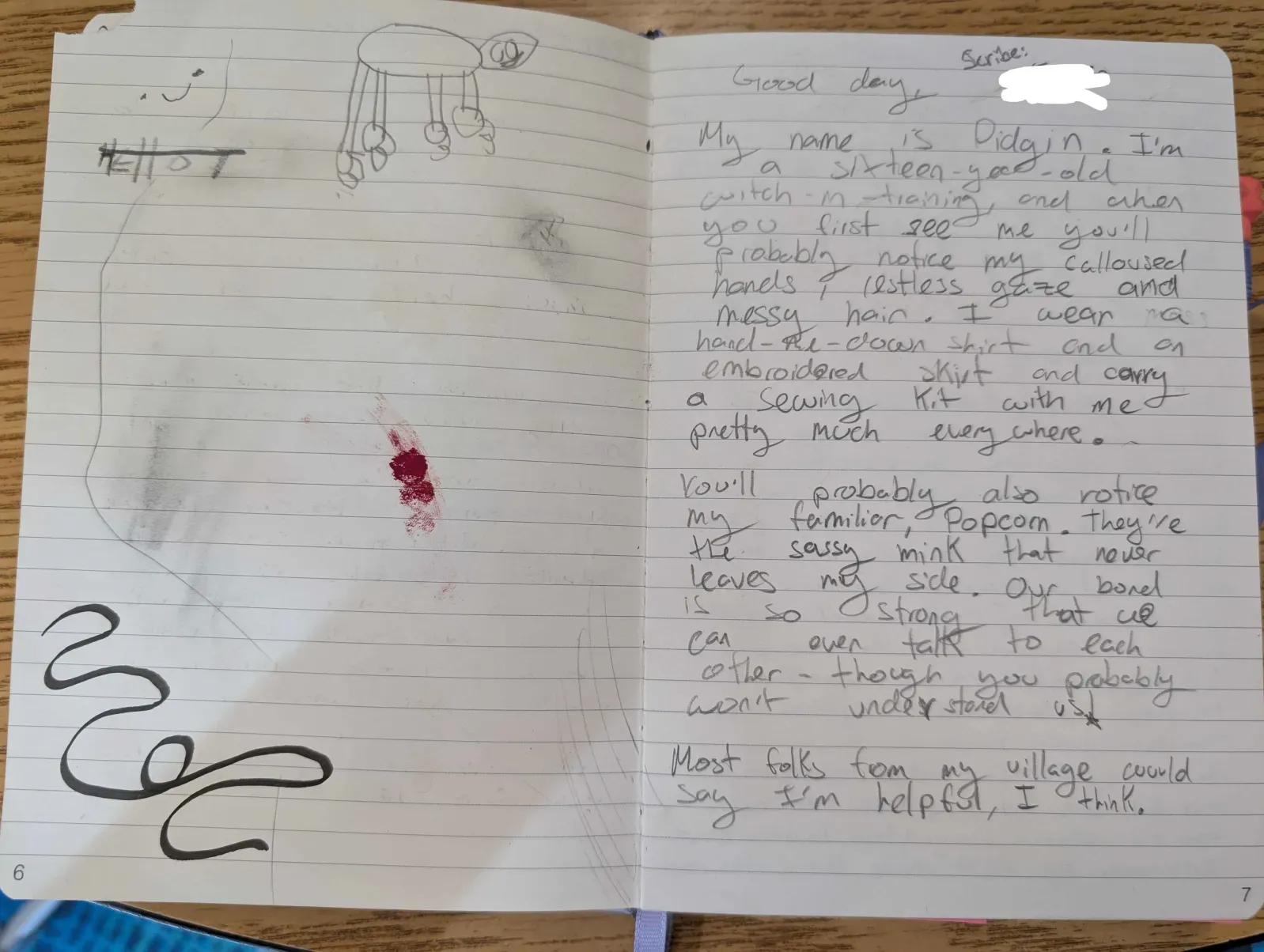
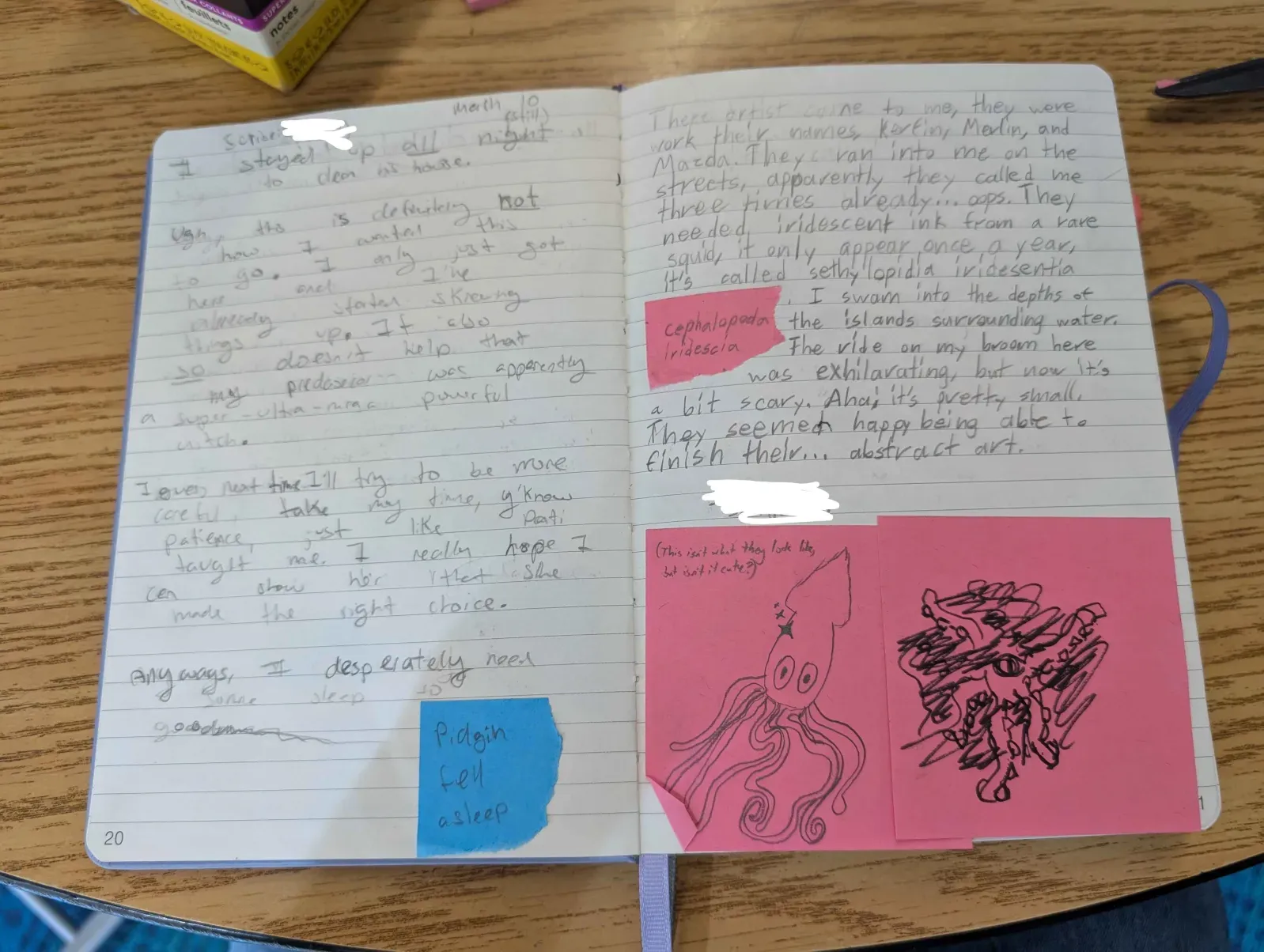
Some small excerpts from Pidgin's diary