Spinning on the Loom: Dropping the Rope


This post is part of a series of articles I'm writing about the Loom system, a diceless, GM-less game system I designed. If you want to tune in and get the posts straight to your inbox, you can subscribe to the Clawhammer Courant for free!
In the last article that I posted, I introduced the concept of player-GM tug-of-war: the table dynamic between GMs and players that results in an "us vs. them" mentality in many traditional roleplaying games. In particular, I concluded that a play-to-die horror story turns this dynamic on its head, aligning the objectives of players and GMs more closely to the interests of a shared narrative. This time, I want to talk about how playbook moves in the Loom work, and how they compare to and are inspired by other game systems that I often see the Loom compared to.
The primary engine behind the Loom system is a series of moves that each playbook has access to. For the most part, in this post, let's focus on Character Playbooks, since that's what I started with when designing the Loom itself.
Character moves are split into three different categories: moves that your character can Always do, moves they can do Once Per Session, and moves they can Never do. At first glance, this is remarkably similar to Realis, Austin Walker's excellent game that wields the power of language to alter the firmament of reality itself. If you want to learn all about Realis in detail, my dear friend Nic Ambrose has a fantastic writeup about it on his new blog, Notes from the Labyrinth.
For our purposes, I'm going to focus on what makes Realis different from the Loom system: the distinction between a "can always" and a simple "always." In Realis, sentences about your character are fundamental truths about them. My Xenagogue, for example, has the sentence, "I always find my way through a conversation by testing limits."
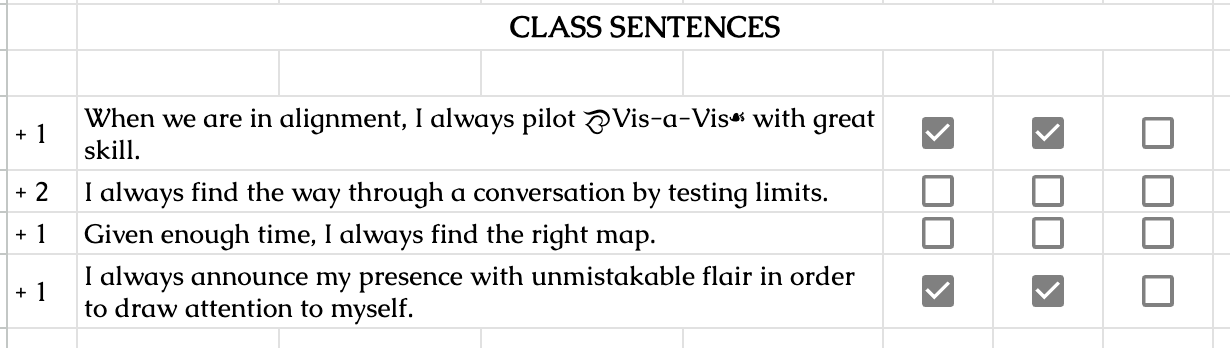
Note that these sentences all assert a truth about what my character is. Not only what they can do, but a fundamental part of who they are. Prothysteron (my Xenagogue character) isn't just able to announce her presence with unmistakable flair in order to draw attention to herself, she always does it. It's not about capability so much as foundational identity.
The conversation between Realis and Belonging Outside Belonging has been better articulated and discussed by smarter, kinder, better looking people than I, but it's a conversation worth at least mentioning here. Realis takes BoB's move structure and juices it to the gills. Characters no longer can, they do. If they don't, that's because someone else's version of reality has been realized instead—a reality where your character's qualities aren't necessarily the same. Your character's reality always allows for you to enact your sentences. If you can't, it's because you've been countered by someone else, not because you chose not to use a move.
Wait. Wasn't this supposed to be an article about the Loom?
In the Loom system, your Always moves are much more closely related to Belonging Outside Belonging moves of the same ilk. I actually started working on the Loom while puzzling over a Belonging Outside Belonging game I was drafting four years ago. What started as a BoB game with a bad case of writer's block evolved into an increasingly desperate series of mechanical maneuvers to find a way, any way to keep working on the game. Eventually, I had contorted the playbooks so severely that they were no longer mechanically recognizable or coherent. Oops.
Once I'd had a sufficient amount of time to bottle up my emotional distress at yet another halted project, I returned to the corpse of my game and sifted through the viscera and giblets to see what I could salvage. (Side note: I'm actually working on a completely new iteration of that game again, four years later, with the incremental help of the undeniable Elliot Davis) Upon my return to the whalefallen Google Drive folder of drafts, snippets, and sundry mechanical tidbits, I noticed a fascinating trend in my own writing habits: I seemed, in retrospect, utterly enamored with contorting moves to assert that you can't do things.
Ultimately, I dropped the tokens from Belonging Outside Belonging entirely. For whatever reason, it wasn't clicking for me in the project I was writing at the time. And in sorting through the carcass, I realized that what I actually wanted wasn't a better way to write Belonging Outside Belonging games, but a new system to write with entirely.
What the Loom does differently from Realis is what it does the same as Belonging Outside Belonging—that its Always moves are enablers, not strictures. But this is where the similarity in move structure to either system ends.
At its core, the Loom is a system about archetype. Where Realis is a game where your character individualizes and self-actualizes over time, the Loom is a system where your playbook is, for the most part, static. Your moves don't change, at least according to the base text. The tension comes not from breaking the rules or altering them, but from getting as close as you can to breaking them without doing so. You're in a cage, and that cage is immutable, but you can throw yourself against the bars in as many different ways as you can think of. Your character doesn't grow mechanically. Instead, the way you play them grows as you find ways around the constraints and limitations put in place around them.
Let's take the Bouncer playbook from the SRD's Appendix B as an example. The Bouncer can Always "clock someone with relative accuracy." When you start play, this might mean that your character is pretty reliably able to punch someone in the jaw, or at least in the vicinity of the jaw. But clocking someone is a phrase with multiple meanings. Over time, as you play The Bouncer, you may find yourself drawn towards alternative interpretations of your moves. A character that starts with a strong left hook can evolve into someone who is a consistently shrewd judge of character, able to clock someone with relative accuracy with a glance.
In this way, the most interesting moves to me in the Loom are your Never moves. In a system where the cage bars are indestructible by design, how can you bend them to give yourself wiggle room? The Lawbringer (Appendix A of the SRD) can Never "compromise on their morals." But can they change their morals if the situation alters their systems of belief? They can't compromise on their morals, but can they compromise their morals directly?
In this way, I use the Once per Session moves as guides for the players to think flexibly about the archetypes they're working with. Once per Session, characters are allowed to bend the rules of their own cage, to buck the trends and expectations of their rigid cast and momentarily become something more. While the Lawbringer can Never compromise on their morals, Once per Session they can "break a law they enforce," communicating to the player that the Lawbringer's morals and their laws are not synonymous and should not be treated as such.
These moves are also subject to flexible interpretation. Once per Session, the Lawbringer can "introduce someone to a different moral perspective." Is that perspective the Lawbringer's, or someone else's? Is the someone another character, or the Lawbringer themselves, choosing to expose their own perspective to a new character's ideas and values? How does this affect the way that you as the player conceptualize the Lawbringer's moral code, and the way it interacts with the laws they enforce?
Realis is a game where you change the mechanical representation of your characters to fit a growing realization of that character's identity. Belonging Outside Belonging is a system where your character's ability to affect the narrative is in constant negotiation with the rhythm of play, ebbing and flowing with the tide of tokens passed around the table.
In the Loom, the only negotiation you engage with is the negotiation of your interpretation of the text itself. You are not working with or against another player to push your character in new mechanical directions. You are not working with or against the GM to achieve mechanical objectives.
You're not really playing tug-of-war at all, anymore. If you're playing the Loom, you've dropped the rope.